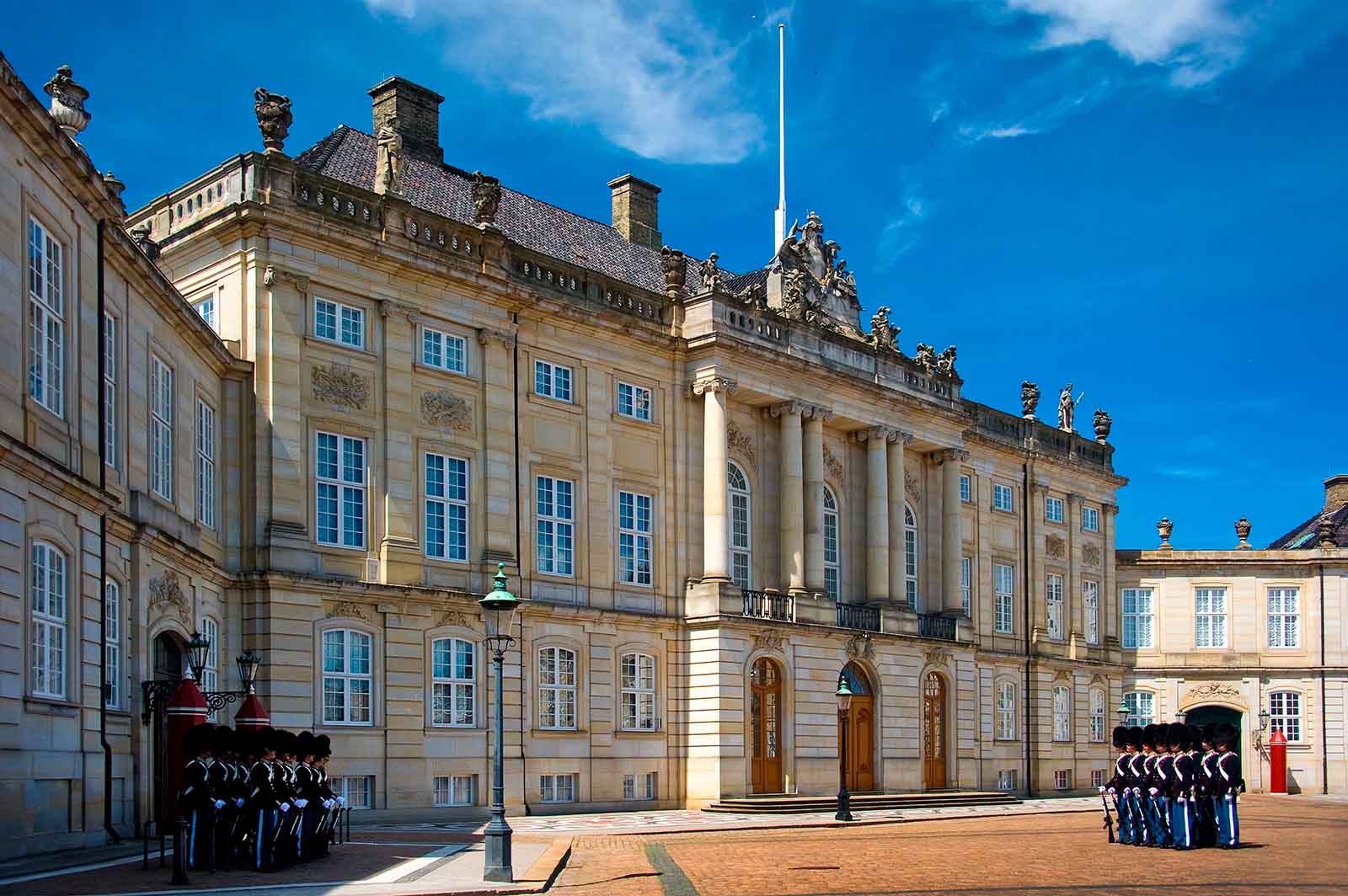
Amalienborg Palace Square
Amalienborg Palace is the home of the royal family and most people agree it is the most beautiful square in Copenhagen.
Originally the palace was built in the middle of the 1700s by four noble families. The royal family bought the buildings in 1794 when Christiansborg Palace burnt down.
The Guards
The royal family and the tourists at the square are protected by the Royal Life Guard. Do not get too close to them. They carry live ammunition and you must keep a respectful distance. It is the oldest regiment in Denmark and one of the toughest and most disciplined in the Danish Army. Their history goes back to the 1600s and they have fought in every war since then including the Second World War, Iraq and Afghanistan. One branch of the regiment protects the royal family at their palaces. You will notice that their boots and equipment are always shining as they take great pride in their appearance.
The Equestrian Statue
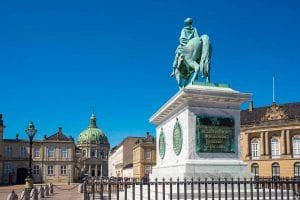
King Frederik V required the noblemen who built the palace to raise a statue of himself in the middle of the square. It took the famous French sculptor Saly 14 years to finish the statue and it was more expensive than the four mansions put together. It is considered a masterpiece by people interested in statues.
The Marble Church
The Garden and The Opera House
The Amalie Garden between the harbour and Amalienborg was a gift from the owner of the Mærsk shipping company to the city of Copenhagen. Before the garden was established in 1983, the area was used as a shipyard and later a port terminal with a direct line sailing Danish emigrants to America.
At the opposite end of the axis, the Copenhagen Opera House from 2005 is also a gift from the owner of Mærsk to the Danish state. With construction costs well over 500 million US dollars, it is one of the most expensive opera houses in the world.
World War II at Amalienborg
Amalienborg Palace Square was the scene of some of the heaviest fighting in Denmark during the war. There was fighting here both on April 9, 1940, when Denmark was invaded, and in 1944 when the Germans started rounding up the entire Danish police force to send them to concentration camps.
The Germans had forgotten about a small police force guarding the king at this square. When the policemen heard that their colleagues were being arrested all over the country, they barricaded themselves in the square. A platoon of German soldiers walked into the square by accident and 20 German soldiers were killed. German reinforcements arrived later and a heavy gunfight ensued. No Danes were killed and eventually the Germans left this small police force alone. It was thus one of the few Danish military victories in World War II.
You can still see bullet holes in the walls of some of the buildings in the square.
Opening hours and tickets
The palace square: The outdoor square can be visited without buying a museum ticket. Access may be restricted for royal events or security.
Museum opening hours: 28 March–1 November 2026: daily 10:00–16:00, extended to 17:00 from 27 June–30 August. From 2 November–23 December: Tuesday–Sunday 10:00–16:00; Monday closed. Check the official calendar for Christmas and New Year.
Standard adult museum admission: DKK 135.
Our walking tour visits the square. The museum inside Christian VIII’s Palace is a separate indoor visit.
Checked 29 October 2026. Prices are standard adult rates without discounts. Hours and prices may change.
How to get to Amalienborg Palace Square
Amalienborg Palace Square is a five- to ten-minute walk from Nyhavn. Visit the square on our Copenhagen two-hour walk for beginners and hear the stories behind Copenhagen’s famous sights.